B2B eCommerce

Dan Bronson
Partner, Marketing / SEO / Analytics
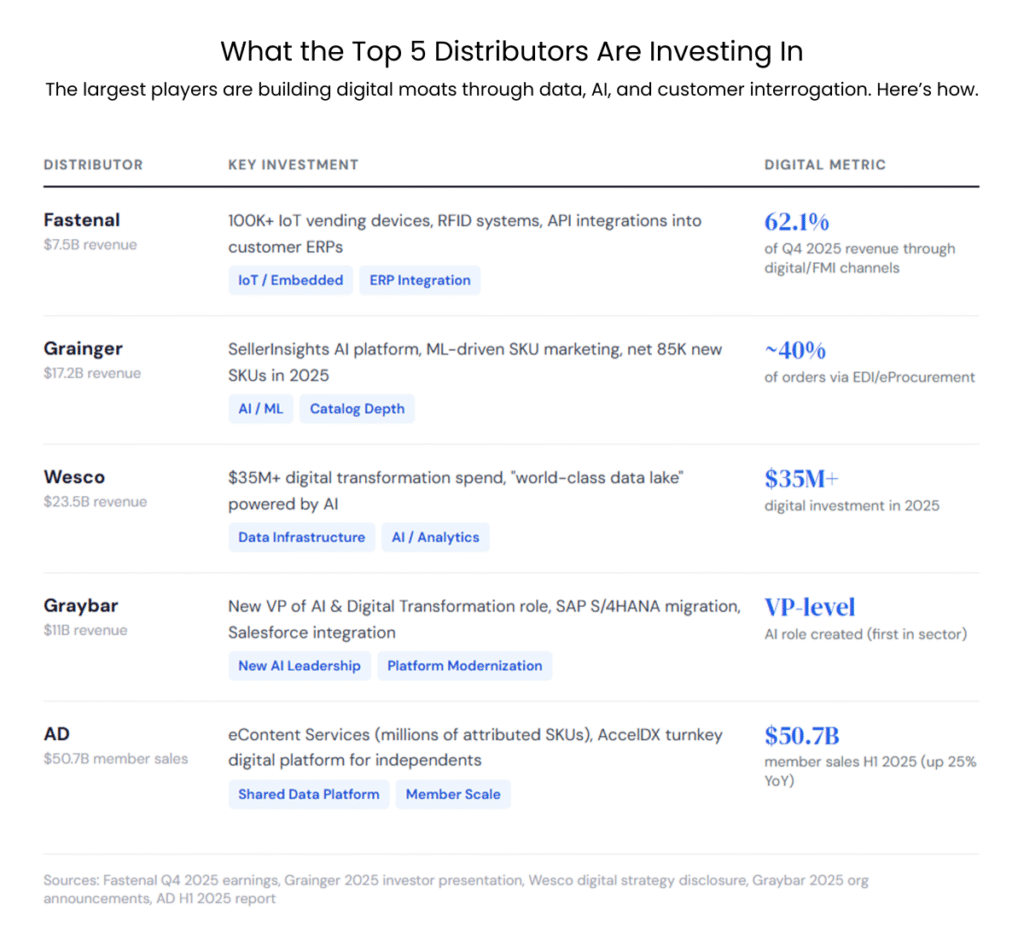
Fastenal now pushes 62% of its revenue through digital and automated channels. Grainger is layering agentic AI onto its KeepStock and sales tools after what executives called “strong usage” in 2025. Wesco committed $35 million to digital transformation, building what it calls a “world-class data lake” powered by AI. And Graybar just created an entirely new executive role: VP of AI and Digital Transformation.
These aren’t experiments. They’re bets on a future where agentic commerce determines which distributor gets the order, not a purchasing manager with a Rolodex.
If you’re running a $50M to $500M industrial distribution company, the question isn’t whether AI will change how your customers buy. It already is. The question is whether your business is visible to the algorithms doing the buying.
What Is Agentic Commerce, and Why Should Distributors Care Right Now?
So what is agentic commerce? It’s the shift from humans browsing websites to AI agents autonomously discovering, comparing, and purchasing products on behalf of buyers. Two new open protocols landed in the past year that make this real. Google’s Universal Commerce Protocol (UCP) and OpenAI’s Agentic Commerce Protocol (ACP) are building the plumbing for AI agents to discover products, compare prices, check inventory, and complete purchases without a human ever visiting a website. UCP already has co-development partners including Shopify, The Home Depot, Walmart, Best Buy, Visa, Mastercard, and Stripe.
On the consumer side, OpenAI’s Instant Checkout feature went live in September 2025 for ChatGPT’s 700+ million weekly active users. Traffic to retail sites from agentic AI browsers and chat services jumped 4,700% year-over-year in July 2025, according to BCG and Adobe data. Those AI-driven visitors spend 32% more time on site and bounce 27% less often than traditional traffic.
Gartner projects that AI agents will intermediate more than $15 trillion in B2B spending by 2028, with 90% of B2B purchases handled through agentic commerce channels. D.A. Davidson estimates this could double online retail’s annual penetration growth rate.
Here’s the counterpoint worth keeping in mind: Gartner also predicts more than 40% of agentic AI projects will be canceled by 2027 due to unclear ROI. Forrester reports only 24% of US adults trust AI agents for routine purchases. Coveo argues fewer than 5% of enterprise applications contain true AI agents, calling most current offerings “agentic AI washing.”
The direction is clear. The timeline is debatable. But the smartest distributors aren’t waiting for certainty. They’re building capabilities that pay off now and position them for AI procurement, whatever the arrival date.
Product Data Management Is the New Storefront for AI Discovery
Conventional wisdom says your website and your sales reps are your storefront. Kearney’s analysis says otherwise: “The new storefront for distributors isn’t your website or your sales rep. It’s the algorithm that determines what your customer’s AI sees first.”
Only 11% of B2B companies have 75% or more of their content ready for AI discovery, according to a 2025 AI Search Study. More than a third of ecommerce sites don’t use structured data markup at all. That’s a massive visibility gap, and it starts with product data management.
Think about what this means in practice. A contractor’s agentic AI system needs 500 feet of 12/2 Romex wire delivered to a jobsite in Houston by tomorrow morning. The agent queries multiple distributors simultaneously. If your product pages lack structured schema markup, if your specs are locked inside PDFs instead of HTML, if your inventory data isn’t accessible in real time, the agent simply skips you. It doesn’t send you a polite email asking for a quote. It doesn’t call your inside sales team. You never existed.
BCG puts it plainly: companies must invest in “AI-ready content operations: structuring data and assets so they are authoritative, semantically rich, factual, and machine-readable.” Product data management for agentic commerce isn’t a marketing project. It’s an operational requirement that determines whether AI agents in B2B digital commerce even know you’re there.
For mid-market distributors who can’t spend millions on data infrastructure, buying groups offer a realistic path. AD’s eContent Services provides millions of attributed SKUs to member distributors at scale. Their AccelDX platform delivers turnkey digital presence for independents. These shared product data management resources may be the only practical way for a $30M electrical distributor to reach AI readiness without a dedicated data team.

AI Procurement Agents Will Squeeze Your Margins, Unless You Bundle Smarter
Simon-Kucher’s pricing experts delivered a warning that should keep every distribution executive up at night: agentic AI removes “the frictions that still protect pricing power: time constraints, incomplete information, and high manual effort.” When a buyer’s AI procurement agent can instantly compare your price against twelve competitors on every line item, the game changes fast.
Kearney’s analysis quantifies the damage: distributors face up to 500 basis points of EBIT erosion from AI procurement pressure in an agentic commerce environment. Average selling prices could decline roughly 8%. Fulfillment costs could rise 10 to 15%. Platform and agent fees could add about 4% per transaction.
Tariffs make this worse. Steel and aluminum tariffs sit at 50%. Copper derivatives face the same. The 2025-2026 tariff regime, the most aggressive since 1930 according to Michigan State University researchers, has squeezed distributors from the supply side at the same time agentic AI is squeezing them on the sell side.
D.A. Davidson notes that “AI tends to purchase only what’s needed,” reducing the impulse add-ons and cross-sells that distributors have relied on for margin enhancement. Your $4 pack of wire nuts thrown onto a $200 wire order? An AI procurement agent won’t bite.
The defensive strategy isn’t price matching. It’s bundling services that reduce pure price comparability. If you’re a $75M HVAC distributor in the Midwest, your technical support staff, safety compliance consulting, jobsite kitting, VMI programs, and emergency delivery capabilities are real competitive advantages. But here’s the catch: those services are invisible to agentic commerce systems unless you structure and publish them in machine-readable formats alongside your product data.
Simon-Kucher recommends performance-based pricing, subscription models, and product-service bundles as the primary margin protection strategy in an agent-mediated market. The distributors who can encode their relationship value into data that agentic AI can read and weigh will hold their margins. The ones who rely on handshakes and phone calls won’t.
Digital Transformation for Distributors: What the Leaders Are Actually Doing
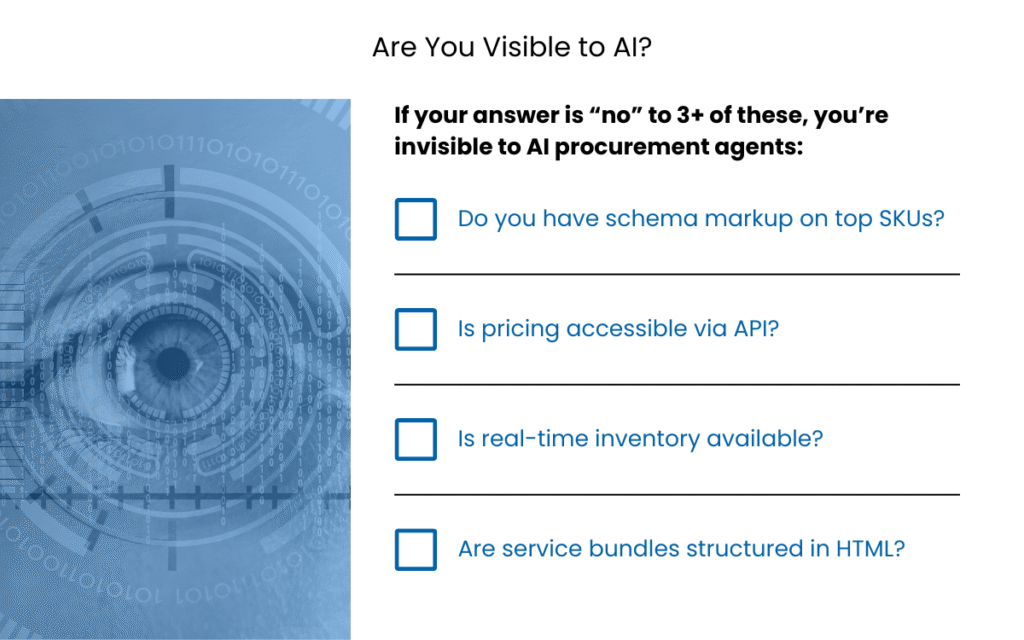
The practical playbook for agentic commerce readiness in distribution comes down to four priorities that deliver value today, regardless of how fast AI procurement adoption arrives.- The first is a product data management audit. Assess every active SKU for structured schema markup, complete technical attributes in HTML (not buried in PDFs), and proper categorization under industry standards like ETIM for electrical and industrial, or AHRI for HVAC. Start with the top 20% of SKUs by revenue. This work improves your site search, SEO, and EDI performance immediately.
- The second priority is real-time API infrastructure. Agentic AI systems need four things answered instantly: pricing, inventory availability by location, delivery estimates, and promotions. A read-only inventory availability API for your main distribution center is a solid starting point. Customer-authenticated pricing APIs come next. Even before full agentic commerce takes hold, these APIs improve your eProcurement integrations and customer portal performance.
- The third is deepening customer integration to build switching costs. Fastenal’s model proves this works: 100,000+ IoT vending devices, RFID systems, and API integrations into customer ERPs create structural barriers that no AI procurement agent can easily route around. Grainger reports the “vast majority” of contract customers now combine eProcurement and KeepStock on-site. If you’re not tracking how many of your top 50 accounts have two or more embedded digital touchpoints, start now.
- The fourth priority is deploying agentic AI internally for high-ROI tasks before worrying about external agentic commerce. Supplier data onboarding, routine quote generation, inside sales email triage, demand forecasting, and dynamic pricing optimization all deliver measurable labor savings and margin improvement. The NAW Innovators Summit featured domain-specific AI agents that handle “high-volume, low-margin supply chain chores: chasing confirmations, keying invoices, updating your ERP.” These tools pay for themselves in weeks, not years.
The Counterintuitive Opportunity for Local and Specialty Distributors
The dominant story around agentic commerce assumes that scale players win. Bigger catalog, lower price, faster algorithm, game over. But think through what an agentic AI system actually optimizes for.
A general contractor’s AI needs a specific NEMA 4X disconnect switch available for same-day pickup at a jobsite in Mesquite, Texas. The agent doesn’t care about catalog breadth. It cares about the right part, at the right place, at the right time. The local electrical distributor with a real-time inventory API and location-specific fulfillment data can beat Grainger’s centralized distribution center on that query, every time.
Agentic commerce rewards specificity and availability, not just scale and price. If your product data management is solid, your inventory is visible in real time, and your local delivery capability is encoded in structured formats, AI procurement agents will find you. For the 73% of B2B buyers who are now millennials (LinkedIn’s 2025 B2B Buyer Report), and the 29% of buyers under 30 who expect AI-driven personalization (Digital Commerce 360), your digital readiness matters more than the size of your warehouse.
The distributors who treat agentic AI readiness as somebody else’s problem will find themselves invisible to the buyers who matter most. The ones who start with product data management, build API infrastructure, and encode their local expertise into formats that machines can read will thrive, whether agentic commerce arrives in 2027 or 2030. The work pays off either way.
About Dan Bronson
Dan Bronson is a Partner at ImpaqX, leading Marketing, SEO, and Analytics strategies that help B2B eCommerce companies turn data into measurable growth. He works with distribution and manufacturing teams to strengthen digital visibility, optimize performance, and build scalable marketing systems that drive revenue.
Connect with Dan on LinkedIn, where he shares insights on digital strategy, search visibility, analytics, and the evolving landscape of B2B growth. Dan Bronson’s LinkedIn Profile